
Who Is Euladora Rose? Seeing the World Between Realism and Abstraction
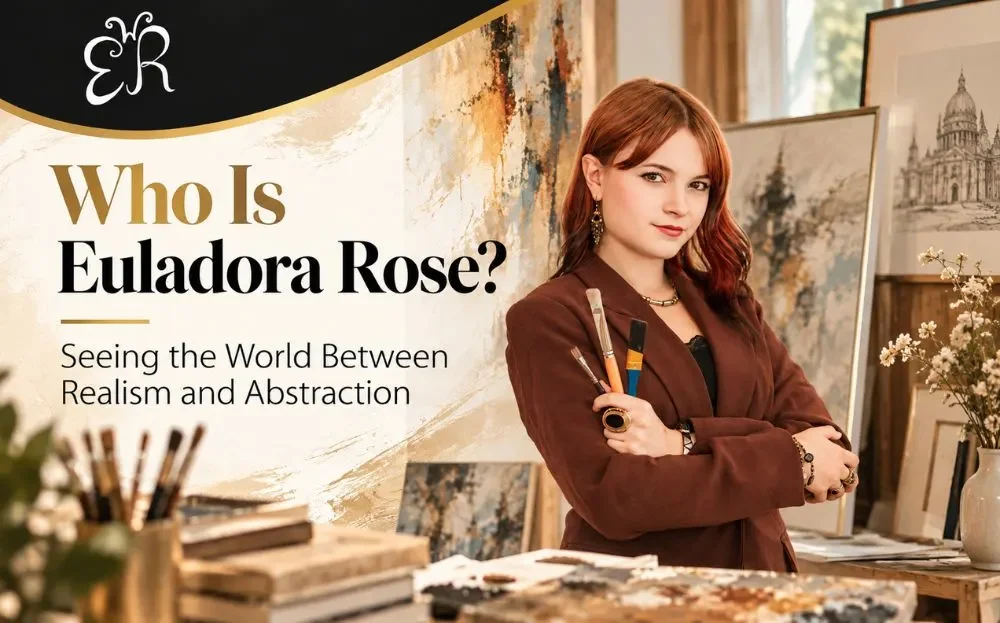
Stand at the edge of the ocean and ask yourself what you are actually looking at.
A geologist sees water meeting sediment. A swimmer sees a mood: calm, cold, inviting, or threatening. Someone who grew up near the shore sees a specific afternoon, the smell of salt and seaweed, a voice calling them in for dinner. None of them is wrong. The ocean is all of those things at once, and which one you see depends on who you are.
That gap, between what something is and what it means to the person looking, is where my work lives.
I’m Euladora Rose, an emerging artist and designer. This post is the longer answer to a question I get in many forms: what kind of artist are you? It covers how I think, why my portfolio moves between painting, mechanical parts, and architecture instead of settling into one style, and one artwork that captures the idea. If you’re here because you searched my name, welcome. If you found me through the art, even better.
THE SHORT ANSWER
Euladora Rose is an emerging fine artist and designer who blends realism with abstraction to show the imaginative side of reality. Her work spans painting, mechanical parts, and architectural design, and rests on one idea: what things “are” depends on how we understand them. Her artwork has been exhibited at Kolman & Reeb Art Gallery in Minneapolis and Emerge Art Gallery in Greenville, NC, and published in Novum Artis magazine.
Realism and Abstraction in Plain Language
Because so much of my work sits between these two approaches, it helps to define them without art-school jargon.
| Realism | Abstraction | |
|---|---|---|
| What it does | Shows a subject the way it appears to the eye | Uses color, shape, line, and texture to suggest rather than depict |
| What it offers | Recognition: you instantly know what you’re looking at | Interpretation: you bring your own feelings and memories to it |
| Its risk | Can stop at the surface and say only what a photograph would | Can feel distant if the viewer has nothing familiar to hold onto |
Each one covers the other’s weak spot. Realism without abstraction can be accurate but emotionally flat. Abstraction without realism can be expressive but hard to enter. When I blend them, the recognizable part gives you a way in, and the abstract part takes you somewhere a literal image couldn’t. That overlap is the space I’m most interested in exploring.
My Artistic Philosophy: What Things “Are” Depends on How We Understand Them
In plain language: an object is never only its physical makeup. A photograph of a tree and the tree you climbed as a kid can be the same plant, but they are not the same thing. One is a subject. The other is a memory, a place, a feeling of being small and brave at the same time.
I believe reality has an imaginative side that we usually walk past. We label things quickly (a wave, a dog, a stranger on a train) and move on. But every one of those things also carries the emotions, places, and memories it reminds us of, and that part is real too. It just doesn’t show up in a literal depiction.
So I use realism and abstraction as two halves of one sentence. I’m not interested in showing you what you would have seen anyway. I want to push the boundaries of conventional expression far enough to reveal the deeper meaning we don’t automatically see, and then give those ideas a tangible form that other people can connect to. For me, art is a way to experiment with ideas and make them something you can stand in front of.
How to look at my work
If you’re new to blended realism and abstraction, this is a simple way in:
Start with what you recognize. Find the part that feels familiar, whether it’s a shape, a creature, or a gesture.
Notice where it stops being literal. Look for the place where color, form, or material stops obeying the real world.
Ask what that shift reminds you of. There’s no correct answer. Your memory is part of the artwork.
Where My Ideas Come From
My subjects are broad on purpose: the ocean, animals, experiences, and people. What connects them is not a look but a way of paying attention. Each is something that means different things to different observers, which makes it perfect material for an artist who cares about perception.
The ocean is a good example because it’s so large that everyone projects something onto it. Animals are another, because we read personality, fear, and tenderness into creatures that can’t tell us what they feel. People are the most complicated of all, since the way someone looks to you is shaped by everything you know about them. I try to make work that honors that gap instead of hiding it.
Why I Work Across Painting, Mechanical Parts, and Architecture
I’m not committed to a single style or theme. I’m drawn to the many unique parts of this complex world, and that includes materials as well as ideas. I believe all things can, and should, be used to create art, from paint to mechanical parts. Each medium lets me ask the same question in a different language.
Painting: emotion and memory on a surface
Painting is where color and surface can carry feeling most directly. It is how I translate the ocean, animals, experiences, and people I’m drawn to into something that reflects how I perceive them rather than only how they look. A single change in color or a softened edge can shift a subject from observed to remembered.
Mechanical parts: giving function a second life
Paint isn’t the only way to change what something “is.” A mechanical part was made to do a job. When it becomes part of an artwork, it’s suddenly something to look at, touch, and wonder about. Working with industrial and found materials pushes my philosophy out of the image and into the material itself, because the object’s history comes with it.
Architecture and design: spaces people live inside
Beyond fine art, I love capturing the delicate beauty of the spaces we live in. The spatial world interacts with the mental, emotional, and physiological worlds of every person, so I try to balance all three in what I design, from architecture to product ideas. A good building is more than functional. It is a web of experiences that is different for every person who enters it.
What I design often reflects my own perspective and community interactions, and in time I hope to give a voice to other people’s inner worlds as well. You can see how this thinking shows up in real projects through my Design Notebook and my fieldwork, including Project Aster 2.0, the Atlas Cultural Foundation, and the Golden Valley Community Store.
How the three practices connect:
| Practice | The question it lets me ask | Where to explore it |
|---|---|---|
| Painting | How can color and surface carry emotion and memory? | Selected Work |
| Mechanical parts | What happens when a made-for-purpose object becomes something to contemplate? | Selected Work · Experience through Insects |
| Architecture & design | How does a space shape how a person thinks, feels, and moves? | Design Notebook · Fieldwork |
It may look like three separate careers, but to me it’s one practice. Whether I’m holding a brush, a machine part, or a floor plan, I’m asking how something looks, what it means, and who it means it to.
Featured Artwork: “Reflection”
“Reflection” is currently on view in The Big Tiny Show at the Kolman & Reeb Art Gallery in Minneapolis, Minnesota. I chose it as the first featured piece here because the title says what my philosophy says. A reflection is the clearest example of something that both is and isn’t what it shows: it looks exactly like the original, and it is not the original. It can also change completely depending on the surface it appears on and who is standing in front of it.
If you want to follow my exhibitions and publications as they happen, the timeline is updated with each milestone. Recent ones include:
The Big Tiny Show (Kolman & Reeb Art Gallery, Minneapolis, MN), featuring “Reflection.”
Schwa Show (Emerge Art Gallery, Greenville, NC), featuring “Birth.”
Novum Artis, Issue 015, where “Self” and “Untitled (tree)” were published in a global magazine my timeline notes reaches over 10,000 readers.
University of Minnesota Continuing Education shared my story as a full-time PSEO student.
What You’ll Find on This Blog
This blog is where the thinking behind the artwork lives. Expect:
Artwork stories: the idea, the materials, and the choices behind individual pieces.
Studio notes: experiments with paint, mechanical parts, and unexpected materials.
Design thinking: how architecture and spatial design connect to emotion and perception.
Exhibition and publication updates: with the context that a gallery wall label can’t give you.
To read more about my background, visit my bio or view my resume.
Explore the Portfolio
The best next step is to see the work itself. Browse my Selected Work and notice where each piece moves from recognizable to imagined. If something resonates, or you’d like to talk about a collaboration, exhibition, or design project, get in touch or email info@euladora.com.
Frequently Asked Questions
-
Euladora Rose is an emerging artist and designer whose work blends realism with abstraction across painting, mechanical parts, and architecture. Her exhibited work includes “Reflection” and “Birth,” and her artwork has been published in Novum Artis magazine.
-
She doesn’t commit to a single style. Her consistent thread is blending realism with abstraction to show how emotions, places, and memories shape what we think things “are.”
-
It means pairing recognizable subject matter with abstract choices in color, form, or texture. The realistic element gives viewers something familiar to hold onto, and the abstract element opens space for feeling, memory, and interpretation.
-
No. Alongside painting, she works with mechanical parts as an artistic material and creates architectural and product design. All of it is explored through the same question of how perception changes meaning.
-
Her Selected Work page is the main online portfolio, and her timeline lists current exhibitions and publications, including shows in Minneapolis, MN and Greenville, NC.
-
Use the contact page or email info@euladora.com. Include a short description of your project or inquiry so the conversation can start with context.
