
Year Completed: 2026
Platform: Adobe Illustrator
Installation Concept
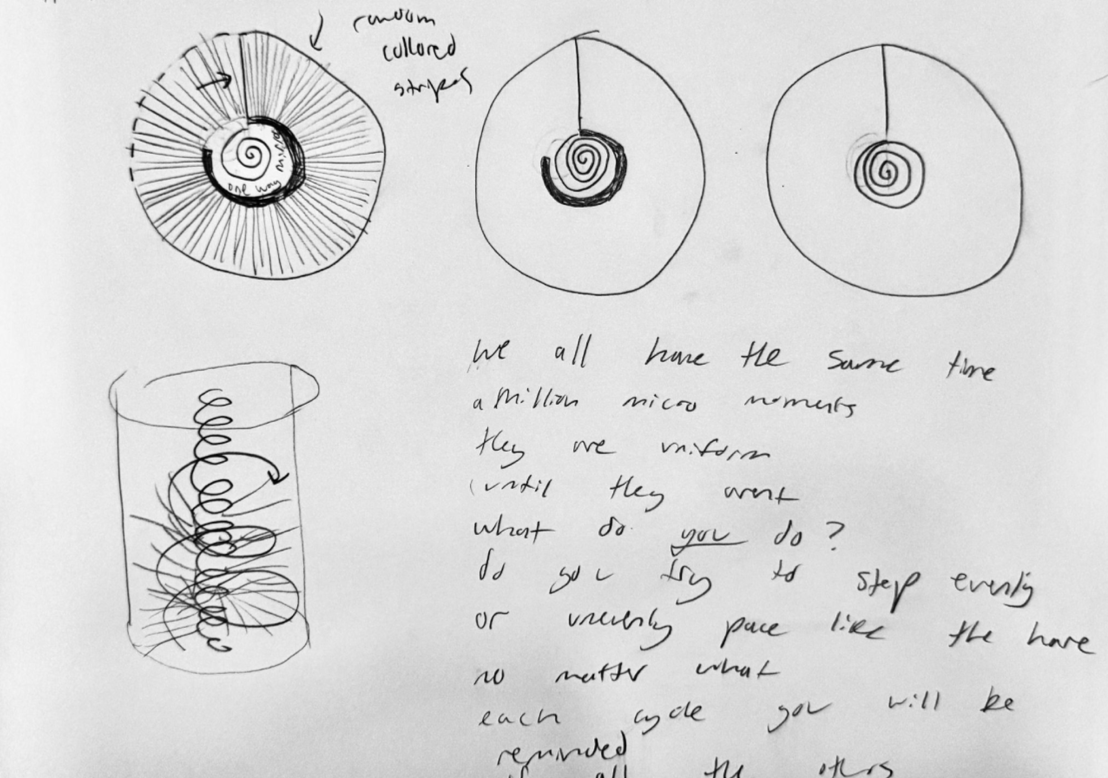
A Million Moments is a conceptual installation designed to make the experience of time physically tangible. At its center is a spiral staircase composed of unusually small steps, approximately five inches deep and four inches high. By disrupting the familiar rhythm of walking, the staircase encourages visitors to become conscious of their movement. Each person must determine their own pace, whether carefully measuring each step or moving intuitively through the structure.
A central column of one-way mirrors gradually reveals a spiraling marble track as visitors ascend. The marbles follow separate paths, occasionally crossing or converging, representing the overlapping timelines of individual lives. The mirrors also allow visitors to look back through portions of the staircase they have already traveled, reflecting how hindsight changes our understanding of past experiences.
Layers of colored paint on the stairs would gradually wear away through repeated use, physically recording the passage of time and the accumulation of individual journeys. The changing colors would also allow visitors to associate the experience with their own emotions and memories.
After several rotations, visitors would encounter an impassable mirrored door, requiring them to retrace their steps. The inaccessible destination represents the uncertainty of the future, while the descent encourages reflection on what has already been experienced. Despite the physical effort involved, the staircase ultimately leads nowhere, creating an opportunity to experience time without the expectation of productivity or a final destination.
Ultimately, A Million Moments is not intended to explain what time is, but to create an experience through which people can examine their own relationship with it. Everyone encounters the same staircase, yet no two people experience the journey in quite the same way.
Research & Inspiration
A Million Moments began as an exploration of the relationship between measured time and our individual experiences of it. Although clocks and calendars divide time into consistent units, the way we perceive those units is far from universal. Through research, observation, and artistic experimentation, I investigated a central question: How do different people imagine time differently?
My exploration began with the work of Jenny Odell, Ryan Gander, and Alicja Kwade, whose approaches to time, productivity, and perception challenged my understanding of something we often consider objective. An exercise in which I spent fifteen minutes doing nothing further revealed how differently time can be experienced. Although everyone participating occupied the same space for the same duration, our internal experiences varied considerably.
I also conducted a small experiment asking people to illustrate how they visualize a year. Their responses revealed remarkably different mental representations of the same twelve months. Some imagined circles, others linear arrangements or repeating cycles. I became particularly interested in the contradiction that time can be both uniform in measurement and deeply personal in experience.
This research led me to consider the spiral as a representation of time. Unlike a circle, which continually returns to its starting point, a spiral can revisit familiar positions while progressing into new territory. This relationship between repetition and change became the foundation for my installation concept.