
Experience Through Insects: What Euladora Rose’s Series Says About Perspective
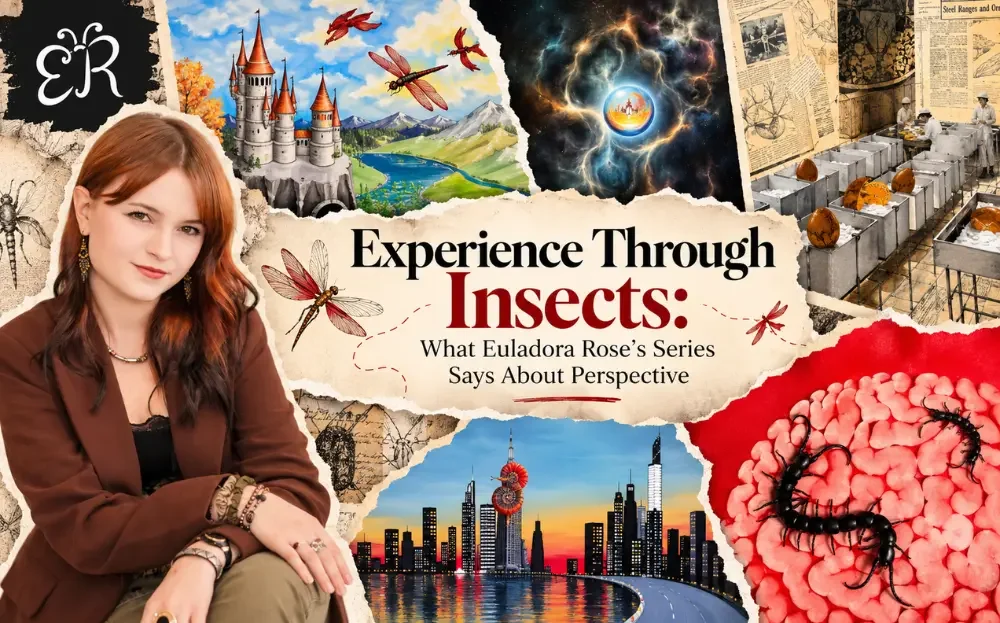
Experience Through Insects is an eight-work visual art series (2025–2026) by Minnesota artist Euladora Rose. It uses insect life, with its instinct, repetition and survival, as a mirror for human growth, showing how emergence, curiosity, structure and conformity look from another creature’s point of view.
Perspective is the method of the series. Each insect scene stands in for a human moment: arriving somewhere unfamiliar, imagining without limits, standing in a school hallway under pressure to fit in, or handing your inner life to someone else. Moving the viewpoint into something small lets familiar experiences be seen without the usual assumptions that come with them.
What Is the Experience Through Insects Series?
The series is eight works made across 2025 and 2026. It does not illustrate a literal life story. Its works move between moments that felt significant to the artist: discovering the world, entering structured environments, feeling pressure to conform, forming relationships and learning that identity keeps changing.
Read in order, they trace a loose arc of emergence, discovery, structure and connection. Birth, a collage painting of bug-egg infants hatching in a colorless 1920s nursery, is the first image on the series page, and it shows how the work treats insects: not as scientific specimens, but as characters living through very human situations.
The works range from acrylic and oil painting to watercolor, scrap metal, wire and carved balsa wood, so the variety lives in the materials while the central idea stays constant. A viewer does not need to know anything about insects to follow it, because each work is built around a feeling most people recognize.
Why Does Euladora Rose Use Insects to Explore Human Perspective?
Insects have long worked as symbols in art. Metamorphosis suggests change, and ant colonies and hives suggest life lived as part of a crowd. Experience Through Insects fits that tradition, but its main interest is perspective.
Insects are small, numerous and usually seen from above, which makes them an unusual choice for talking about human feeling. That distance is what the series uses. Insect life runs on instinct, repetition and survival, qualities that also shape human routines but are rarely examined from the outside.
One way to read the series: a roly-poly curled inside a school locker turns an animal habit into a picture of the facade students build against bullying and academic pressure. Identical grey ants dragging one orange ant apart do the same for conformity, since the hive-minded crowd is an insect behavior and the pressure to become the same is a human one.
The Eight Works at a Glance
Each work stands for a human moment. The table lists its phase, medium, size and the moment it carries.
| Work | Phase | Medium | Size | Human moment |
|---|---|---|---|---|
| Genesis | Emergence | Acrylic and oil on handmade canvas | 16″ x 16″ | The potential of a life |
| Birth | Emergence | Vintage collage, acrylic, oil, sponge | 22″ x 28″ | Arriving somewhere unfamiliar |
| Imagination | Discovery | Watercolor, india ink, pencil | 11″ x 18″ | Childhood as invention |
| Exploration | Discovery | Scrap metal, electronics, cardstock, acrylic | 20″ x 30″ | Fearless curiosity |
| Locker | Structure | Cardstock, paper, watercolor, acrylic | 4″ x 8″ | A hard shell against pressure |
| Conformity | Structure | Acrylic, perforated cardboard, projection | 12″ x 24″ | The pressure to be the same |
| Intrusive Thoughts | Connection | Cardstock, wire, spray paint | 9″ x 11″ | Negative thought loops |
| Love | Connection | Balsa wood, polymer clay, wire, paper | 4″ x 6″ x 7″ | Trusting someone with your mind |
What Are the Four Phases of the Series?
The eight works fall into four phases, each pairing two pieces around one stage of growth.
Emergence: Genesis and Birth
The series opens before form has fully arrived. In Genesis, a bug egg inside a hand-mixed supernova, the burst of energy that starts a life meets its potential. In Birth, bug-egg infants hatching in a 1920s nursery, a world built from cut vintage prints of homes, anatomy and advertisements surrounds them. Neither work shows a fully formed adult creature, which keeps the viewer at the moment before identity takes shape. Ask: what does it feel like to arrive somewhere with no map?
Discovery: Imagination and Exploration
Curiosity takes the lead. Imagination, a storybook page of dragons and one dragonfly, pictures the reader who “flies in” and becomes what they read. Exploration, an oversized cardstock caterpillar on a city of scrap metal and electronics, captures a mind not yet flattened by reality. Both treat childhood as bold and naive, before the edges of the world have been drawn. Ask: when did the world last feel this large?
Structure: Locker and Conformity
Institutions close in. Locker, a roly-poly rolled tight inside a school locker, shows a hard shell against pressure. Conformity, grey ants pulling one orange ant apart, adds a projected video overlay that keeps the piece shifting between still and live. Together they show two responses to pressure: withdraw into a shell, or be pulled toward sameness. Ask: what does it cost to stay different inside a structure?
Connection: Intrusive Thoughts and Love
The final phase turns inward and outward at once. In Intrusive Thoughts, black wire centipedes on a pink cardstock brain, negative thought loops take root and will not leave. Love, a carved anatomical heart swarmed by paper butterflies, carries a handwritten love letter, each butterfly pinned wing by wing. One looks inward at a mind that cannot rest, the other outward at the vulnerability of sharing it. Ask: what is the risk of handing your mind to someone else?
How Do the Materials Carry the Perspective?
The series began primarily through painting. As the ideas became more specific, the materials had to change with them, and Euladora Rose began using found images, cardboard, electronics, wire, wood and projection, choosing each for what it could communicate.
In the artist’s words, “The series became less about depicting an idea and more about building the idea into the object itself.”
The effect shows in the details. In Intrusive Thoughts, the wire centipedes sit directly on the surface of the brain, so the thoughts are literally on top of it. In Conformity, the projection keeps the ants moving, so the pressure never settles into a still image. Exploration builds its city from discarded electronics and metal, and Love is fully sculptural.
Scale shifts the viewer’s position too. Birth measures 22 by 28 inches, while Locker measures only four by eight, so the viewer moves between a wide view and a close, almost insect-level look. The change also mirrors the series’ own subject: a body of work that begins as an image and grows into objects, much like the growth it describes.
What Can Viewers Take From the Series?
The series works on two levels. At first glance it is a set of unusual images: an egg in a supernova, a caterpillar over a circuit-board city, a brain covered in wire. On a second look, each image asks the viewer to recognize something personal, such as the first day somewhere new, the urge to blend in, or the thoughts that will not leave.
Because the insects stay small, instinctive and exposed, the viewer feels the scale of what is at stake without a human figure to identify with. That distance is what makes the shift in perspective possible, and it is why the series rewards a slow second look.
Where Can You See the Series?
The series has been shown in seven exhibitions between 2025 and 2026 and was published in Novum Artis 014. Birth was shown in the Schwa Show at Emerge Gallery in Greenville, North Carolina, and Love in the Gallerium 5th Annual Grand Art Prize. For the rest of her work, browse the Selected Works page.
What the Series Says About Perspective
Experience Through Insects shows that a change of viewpoint can make familiar human moments newly visible. By following small creatures through emergence, curiosity, structure and connection, Euladora Rose turns instinct and repetition into a way of seeing how people grow, conform and love. To see all eight works with their materials and sizes, visit the Experience Through Insects series page. To ask about the work, get in touch.
About the Artist
Euladora Rose is an emerging artist working across fine art and architecture. Her art blends realism with abstraction, and her design work looks at how spaces shape emotional and physical experience.
Frequently Asked Questions
-
Experience Through Insects is an eight-work visual art series by Minnesota artist Euladora Rose, made in 2025 and 2026. It uses insect life as a mirror for human growth, exploring emergence, curiosity, structure, conformity and connection.
-
The series has eight works, created between 2025 and 2026. They are grouped into four phases that follow a loose arc from emergence through discovery and structure to connection.
-
In this series, insect life, with its instinct, repetition and survival, works as a mirror for human growth. Placing human moments inside an insect’s world shifts the viewer’s perspective on them.
-
Emergence is arriving somewhere unfamiliar. Discovery is curiosity and childhood invention. Structure is institutions and the pressure to conform. Connection is the difficulty of a repetitive mind and the risk of trusting someone else with it.
-
The series uses more than 15 mediums, including acrylic, oil, watercolor, india ink, vintage collage, cardstock, scrap metal, electronics, wire, balsa wood, polymer clay and projection, each chosen for what it could communicate.
-
Yes. The series has appeared in seven exhibitions across 2025 and 2026 and was published in Novum Artis 014.
